

Film Review- “The Movie ‘Kotu’ Signals That the Golden Era of Sinhala Cinema Has Begun Again”
www.bbcmirror.lk
www.Lankawebnews.lk
(By Lieutenant Duminda Senarath)
2026-11-17
It is a very happy thing to realize when watching many Sinhala films being made today that the Golden Era of Sinhala Cinema has started now.
For many years, we heard people say Sinhala cinema is dying, that halls are empty, that audiences have left for other languages and other screens. But today, when we look at the films being made, when we look at the crowds gathering outside theatres, when we look at the love people have for our own stories, we can feel it clearly. A new golden era has begun.
Especially the recent film “Eda Raa”, which is based on the life experiences of the late great musician Milton Mallawarachchi, has received a historic response from audiences. The film, directed by Aruna Jayawardena and released on 18 September 2026, explores the life, struggles and musical journey of Milton Mallawarachchi. According to published reports, its earnings have been reported at around Rs. 948 million, making it the highest grossing Sri Lankan film of all time. More than the figure, what is truly heartwarming is the love of the people. That love is a very auspicious sign and a reason for the great success of the entire Sinhala Cinema Industry.
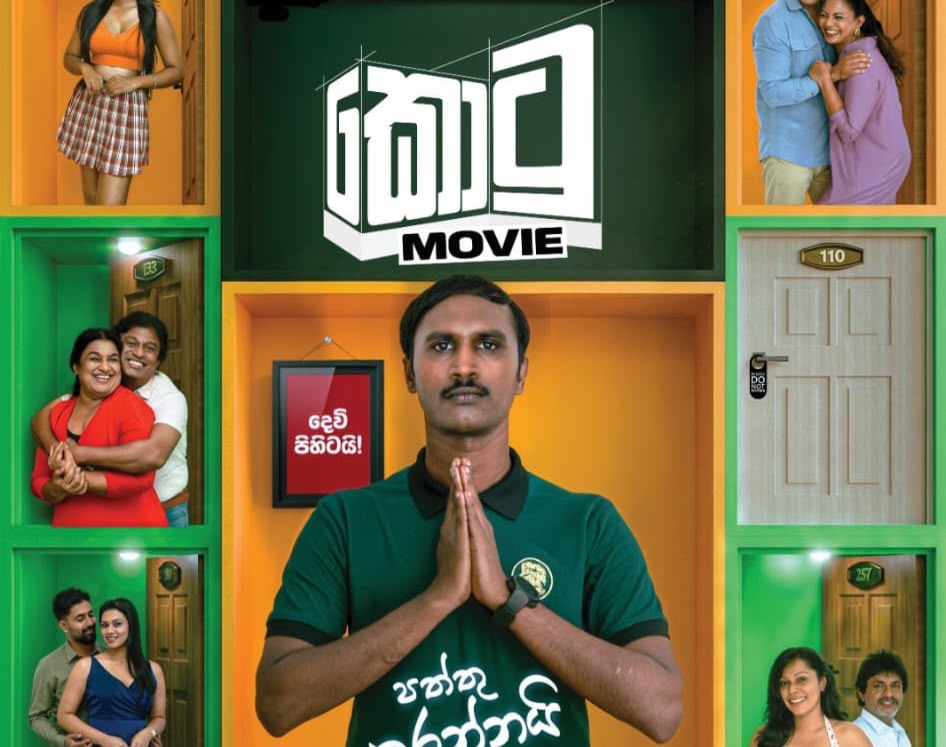
Couple of days ago, I watched the latest movie “Kotu” which directed by veteran Film Director Asanga Sayakkara at Colombo City Centre Cinema. It was produced by Sirasa TV (MTV – Maharaja Organization) and directed by Film Director Asanka Sayakkara.
“Kotu” is a cinematic creation that emerged from the concept of a stage drama and developed into a film. However, it is neither a stage drama nor merely an extension of one. It is a new story built around an original concept based on the context of Kotu. The film is primarily set in the Alakamanda Hotel.
The central character of the story is Kasun. The unconventional actions carried out by him in relation to Sanju, who is the crush of Kasun, create a series of complications in the lives of several couples who visit the hotel.
The storyline revolves around the events that unfold within the hotel. A number of couples arrive at the premises, each carrying their own personal stories and expectations. However, the unusual circumstances created by Kasun and Sanju gradually turn their lives upside down. The film explores these incidents through a combination of humour, unexpected situations and human relationships.
What makes the synopsis so interesting is that the hotel becomes a small world in itself. Behind every closed door there is a different story, and none of the visitors expect that their lives are about to cross. But once Kasun begins his unconventional attempts to get close to Sanju, his crush, inside the hotel, nothing remains as planned. From that confusion, laughter is born, and from that laughter, truth slowly begins to appear.
Kasun is not presented as a villain. He is a young man who acts without thinking about the consequences, who believes he is helping, who believes he is being clever, but who unknowingly pushes others into difficult situations. Sanju is his crush, the centre of his attention and the reason for many of his actions. Together, they become the trigger for everything that happens in the Alakamanda Hotel. The audience laughs at their actions, but at the same time, the audience also feels for the couples whose lives are being turned upside down.
As the story moves forward, each couple is forced to face something they were trying to avoid. In this way, “Kotu” uses humour to show a very human truth. In life, we all live inside a kotu, a cage made of fear, pride, lies, social expectations and past mistakes. We think we are free, but we are trapped. And sometimes, it takes an unexpected incident, an unexpected person, or even an unexpected confusion to break that cage and set us free.
That is why the synopsis of “Kotu” is not just about a hotel and a few couples. It is about all of us. It shows how ordinary people, in an ordinary place, can find themselves in extraordinary situations, and how from those situations, they learn who they really are. The film keeps the audience guessing what will happen next, who will meet whom, which secret will be revealed, and how Kasun and Sanju will finally face the consequences of their own actions.
Watching it at Colombo City Centre Cinema, the experience becomes even more complete. The story does not depend on big fights or loud dialogues. It depends on situations, on timing, on human nature, and on how one small incident inside a hotel can change many lives. That is the strength of “Kotu”.
Asanka Sayakkara is a prominent figure in the field of filmmaking, having established himself through his creative contributions to cinema, television and stage productions. He is a scriptwriter, director and producer. His theatrical production “Kotu” won several awards at the State Drama Festival in 2024, and “Kotu” also gained popularity among television audiences through its teledrama adaptation.
The production company is associated with the Capital Maharaja Organisation, which operates the television channel Sirasa TV and M Entertainments. Among its productions are “Dharmayuddhaya” (2017), directed by Cheyyar Ravi, “Happy Birthday” (2022), directed by Aruna Jayawardena, and “Dharmayuddhaya 2”, directed by Aruna Jayawardena and released on 23 January 2026. The company is preparing to release “Kotu”, directed by Asanka Sayakkara, in 2026, and “Dharmayuddhaya 3”, directed by Aruna Jayawardena, is in production.
It is also a clear indication that if good films are produced, they will attract a strong audience and that film will be a great success. The audience has not left Sinhala cinema. The audience was only waiting for good films. Give them a true story, give them honest acting, give them good music, give them a film made with heart, and they will come. They will fill the halls. They will bring their children. They will talk about the film at home, at work, in the bus, on social media. That is what “Eda Raa” has proved, and that is what “Kotu” is now proving in a different way.
Likewise, we could see several other film directors and producers of Sinhala Cinema are following this pathway to the succession of their profession. They are now choosing true stories, our history, our heroes, our musicians, our writers, our village life, our real emotions, instead of copying foreign films. They are trusting the Sri Lankan story. They are trusting the Sri Lankan audience. And the audience is answering that trust with love and with full theatres.
This is why this moment is so precious. If we protect this momentum, if directors continue to make films with honesty, if producers invest with courage, if audiences continue to support Sinhala films in theatres, then this golden era will not be a short festival. It will become a lasting age.
Sinhala cinema was never just entertainment. It was our mirror. It told us who we are. From the days of “Kadawunu Poronduwa”(The very first movie of the Sinhala Cinema) to the great films of Lester James Peries, to the songs of Milton Mallawarachchi that still live in our hearts, cinema has carried the soul of this island. Today, with “Eda Raa” and with films like “Kotu”, that soul is shining again.
Let us celebrate this golden era. Let us go to the theatre. Let us support our artists. Because when Sinhala cinema wins, Sri Lanka wins.
www.bbcmirror.lk
www.asianewsplusone.com
www.sfmnewslk.com
www.Lankawebnews.lk
www.ceylonwebrepoter.com
www.ceylonwebnews.com
chat.whatsapp.com/Knsroge4upyJzBjJLvNMQS?mode=gi_c
youtube.com/@bbcmirror?si=gUipLaxS2au3wav-
http://www.instagram.com/bbcmirror_media_?igsh=MW5seTc0eW1yYmVsNw%3D%3D&utm_source=qr
